
What is full mouth rehabilitation?
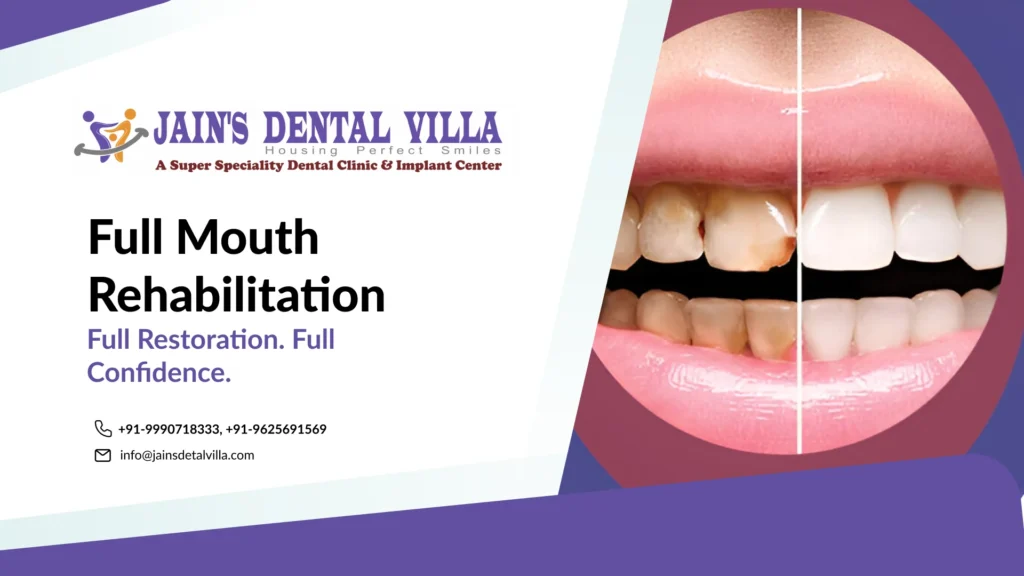
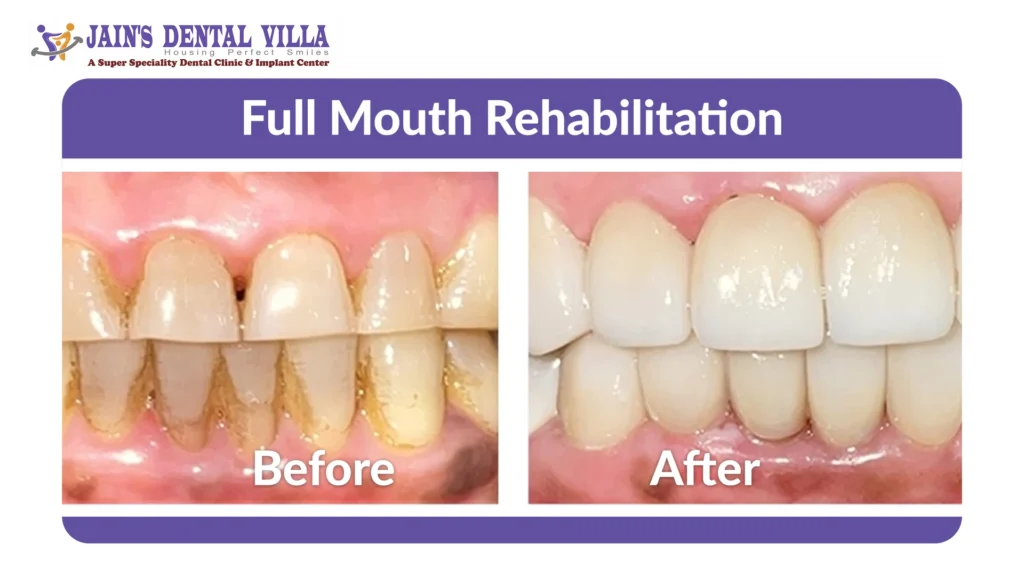
A full mouth rehabilitation is also called a full mouth reconstruction. It is a customized dental treatment plan with the goal of treating oral health issues that affect the teeth, gums, jaws and mouth function. Full mouth reconstruction is the most comprehensive form of dental treatment presently available. This treatment is carried out by a prosthodontist due to the complex nature of the procedure. A full mouth rehabilitation can vastly improve appearance, functionality and overall comfort.
The aim of full mouth rehabilitation is to restore dental function and, at the same time, enhance appearance and oral health. It is a very good choice for those who want to reclaim a bright and confident smile.
Why Choose Jain’s Dental Villa for Full Mouth Rehabilitation?
Our aim at Jain’s Dental Villa is to restore dental function while simultaneously improving aesthetics and oral health. We make sure that the patient is informed about the pros and cons of full mouth reconstruction before the start of the procedure. Our areas of expertise include smile restoration and treatment of periodontal disease. These services can be availed at both of our branches in Ashok Vihar and Paschim Vihar.
Full Mouth Rehabilitation in Ashok Vihar
Full mouth rehabilitation in Ashok Vihar restores damaged, worn or missing teeth with personalized treatments such as crowns, bridges, implants, and bite correction. It improves chewing, appearance, and general oral health, providing patients with a renewed smile, long-lasting comfort under expert dental care.
Our dentists utilize modern diagnostic tools to evaluate your oral condition and outline a personalized treatment plan that covers both function and appearance. Full mouth rehabilitation assists in solving bite problems, strengthening weak teeth, and restoring facial structure. At Jain’s Dental Villa, patients receive accurate, compassionate care for long-term dental stability.
Full Mouth Rehabilitation in Paschim Vihar
Full mouth rehabilitation in Paschim Vihar couples modern restorative methods to rebuild your smile and improve jaw function. With customized planning and advanced equipment, dentists address tooth wear, decay, and bite problems, assisting patients in regaining confidence, comfort, and optimal oral health through comprehensive, targeted treatment.
Each full mouth rehabilitation plan is customized to the patient’s specific dental requirements, ensuring natural-looking results and better functionality. Using high-quality materials and accurate methods, our team restores balance, strengthens weakened teeth, and improves facial structure. Jain’s Dental Villa focuses on reliable outcomes, patient comfort, and long-term oral health.
What are the signs that you require full mouth rehabilitation?
1. Continuous tooth pain and sensitivity.
2. Difficulty in performing basic activities such as chewing and speaking.
3. Stiffness of the jaw, clicking.
4. Shortening, chipping and wearing down of teeth.
5. Recession and bleeding of gums.
6. Shifting and loosening of teeth.
7. Headaches and facial pain.
How long does it take to complete the process of full mouth rehabilitation?
A full mouth rehabilitation is carried out, keeping in mind the requirements of the patient. The treatment process is comprised of a number of steps.
The first step of the process involves the prosthodontist developing a customized treatment plan that is suitable for your oral health condition. A prosthodontist focuses on the restoration and replacement of missing or damaged teeth. The cost of the treatment is also taken into account. The required treatment procedures are carried out, and the patient returns for follow-up consultation during the maintenance phase.
The total treatment time for full mouth rehabilitation varies depending on the oral health condition of the patient involved.
It is quite possible that a large number of dental appointments are required during the course of full mouth rehabilitation. Full mouth reconstruction can take a good amount of time. But the dental appointments can be arranged in such a way that they don’t affect your schedule.
What is the cost of full mouth rehabilitation?
The cost of full mouth rehabilitation depends on a number of factors. It depends on the goals of the treatment, the type of restoration and the number of restorations. The cost of treatment can also be affected by other procedures that may be required. Procedures such as root canal fillings and dental surgery will alter the cost of full mouth reconstruction. A treatment cost estimate can be requested before the actual procedure is started. The cost of full mouth rehabilitation ranges from ₹1,50,000 to ₹6,00,000.
Which specialist performs full mouth rehabilitation?
Tooth restoration and tooth replacement are areas of speciality for prosthodontists. A prosthodontist specialises in the restoration and replacement of missing or damaged teeth. Hence, prosthodontists are the most qualified specialists who perform full mouth reconstruction. Full mouth rehabilitation involves a variety of procedures and is an interdisciplinary treatment. Other dental specialists such as surgeons, endodontists, orthodontists and oral medicine experts may also be required during treatment.
What are the procedures involved in full mouth restoration?
Depending on the nature of the case, the procedures involved in full mouth rehabilitation may vary. Here is a list of common procedures:
1. Dental Fillings: Minor tooth decay can be addressed with the help of dental fillings. The decay is prevented from spreading by using a metal or tooth-coloured material to fill cavities.
2. Dental Bonding: Minimal tooth damage and cosmetic issues can be addressed with the help of dental bonding. A resin material is used for this purpose.
3. Inlays and Onlays: Inlays and onlays are predominantly used to treat molars. Damage to the biting surface of the molar can be addressed with the help of inlays, while onlays are used to target the cusps of the molar.
4. Dental Crowns: Teeth with intact roots that are heavily damaged or decayed are fitted with crowns, which are in essence prosthetic caps. The caps are designed in such a way that they blend seamlessly with your natural teeth.
5. Dental Bridges: A row of one or more prosthetic teeth with a dental crown on either end is known as a dental bridge. It is a tooth replacement device. The prosthetics are installed in the toothless gap, and crowns are attached at either end for strength and support.
6. Dentures: Dentures are predominantly used when several teeth are missing. Adhesives or more permanent dental implants are used for the support and installation of dentures.
7. Dental Implants: The most popular method of tooth replacement is the use of dental implants. These implants provide excellent support for prosthetic teeth. A titanium post is fused to the jawbone in order to provide support.
8. Dental Veneers: The appearance of front-facing teeth that have minor damage or cosmetic issues can be improved with the help of veneers, which are like thin shells. Porcelain is the most common material used for making veneers. Composite resin and ceramic are other materials that can also be used.
9. Teeth Whitening: This is generally the final step in full mouth rehabilitation. Whitening of teeth makes your smile bright and improves your self-confidence.
Additional treatments that do not involve reconstruction or cosmetic dentistry may be required, depending on the nature of the case. Full mouth rehabilitation may also include scaling and root planing, periodontal gum therapy, bone or gum grafts, crown lengthening, orthodontic treatment, and corrective jaw surgery.
Maintaining the results of full mouth rehabilitation
1. Avoid stressful activities for at least 24 hours after the process of full mouth reconstruction. Taking rest by lying down will help you return to normalcy quickly.
2. An icepack can be used to control the swelling and soreness. The icepack can be used 4-5 times a day. If the swelling doesn’t subside within a week, you should call your doctor.
4. The treatment site is very sensitive after the procedure. Hence, it is important not to brush too vigorously or floss in the treated area. Gentle brushing is recommended.
5. Using a mouthwash is a good method to maintain oral hygiene. But it is not advisable to use a mouthwash immediately after treatment because the chemical may be too harsh for the treated site. This should be followed especially when the jawbone is exposed after tooth extraction.
Advantages of Full Mouth Rehabilitation
1. Smile Restoration: Multiple cosmetic issues can be addressed with the help of full mouth reconstruction. Sunken jaw, gum discolouration and gum recession can be treated. Smile design focuses primarily on cosmetic issues, whereas full mouth reconstruction addresses cosmetic concerns that pose oral health issues.
2. Addressing Functional Issues: Patients with missing teeth often avoid certain types of food that are difficult to chew. Full mouth rehabilitation with new teeth helps the patient to eat most types of food without any restrictions.
3. Improved health and appearance of teeth: Full mouth rehabilitation even helps patients who have lost most of their teeth. This allows them to have a natural and healthy smile again.
4. Treating Periodontal Disease: Full mouth rehabilitation can be used to treat periodontal disease. Periodontitis is an advanced stage of periodontal disease. It involves loss of bone, discolouration of gums, gum recession and deep gum pockets. Treatment of periodontal disease and periodontitis can be performed with the help of full mouth reconstruction.
Disadvantages of Full Mouth Rehabilitation
Full mouth reconstruction comes with its own set of cons, just like other dental procedures. The oral health of the patient and the treatment procedure selected are factors that affect the risk associated with full mouth reconstruction. Some of the common disadvantages are:
1. Complications arising out of the treatment procedure.
2. High cost of treatment.
3. Extended period of time for treatment.
An informed decision can be made before the start of the treatment procedure by learning about the risks and disadvantages associated with full mouth rehabilitation.
Full mouth rehabilitation provides a comprehensive solution to restore function, comfort, and appearance. Thanks to expert planning and advanced methods at Jain’s Dental Villa, patients can regain a healthy, confident smile and enjoy lasting improvements in oral health.